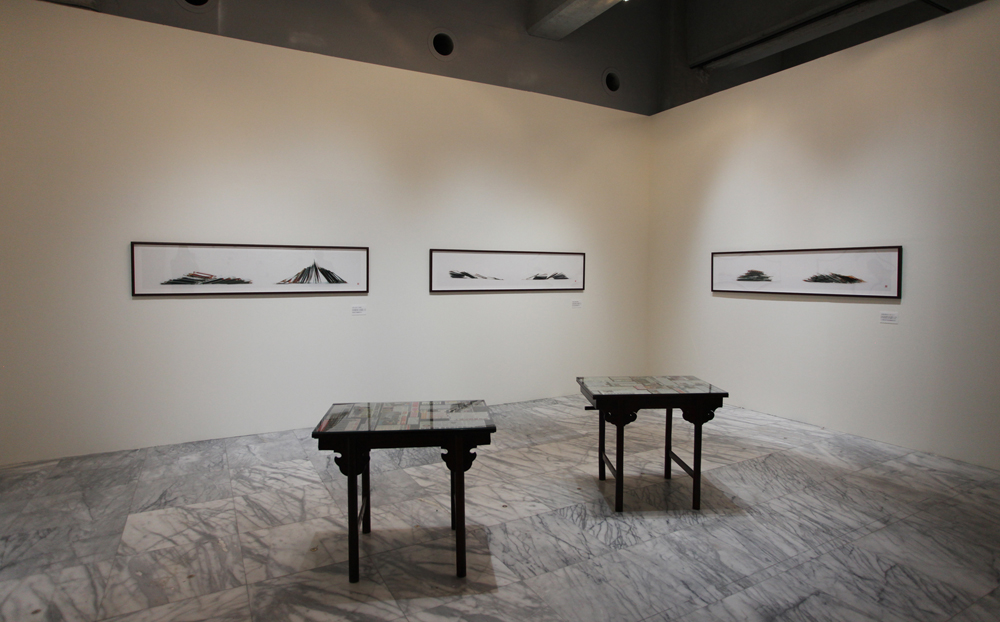
| In Census, Ting-Ting Cheng, who just came back to her home country at the time, explored the | 中文 | |
| exiting value systems in Taiwan, which she couldn’t use to, in a humorous way. | ||
| The project is an experiment. She walked on the street in Taipei and photographed 800 people by | Exhibition View | |
| 35mm negatives. She cut the negatives, and then categorized them in different categories, | ||
| followed by weighing, comparing and photographing the piled-up films. The 8 categories are, | ||
| male, female, foreigners from the West, local Taiwanese, students from National Taiwan | ||
| University, people who are not students from the university, people whose monthly salary is over | ||
| NTD.50000, and people whose salary is lower than the number. And the 8 categories are divided | ||
| in 4 pairs, compared which negatives are heavier than the other, in order to prove or overthrown | ||
| the preference towards male, foreign culture from the west, high-education and wealthiness in | ||
| Taiwan society. | ||
| For example, in the image, “I am a housewife and I would have to give birth to a baby boy so my | ||
| mother in law would be happy.”, The 100 negatives of female weighed 22.1g, heavier then 22g of | ||
| 100 negatives of male. So the theory of ‘male is better than female’ has been overthrown. | ||
| Cheng used this ridiculous method to compare the values of different people, sarcastically | ||
| pointing out the ridiculous value systems existing in the society. In the images, the actual human | ||
| figures on the negatives are hidden, what viewers can see is only the shape of the films; | ||
| symbolizing that the people in the society are categorized by the stereotypes, losing their own | ||
| individual identities. The images are printed by rice paper with stamp, presented like Chinese | ||
| landscape painting, outlining the profile of the city, at the same time, pointing out the effect from | ||
| Confucianism in the value systems. | ||